Right now, as your eyes are reading and tracing these words, billions of tiny molecular gates are opening and shutting inside your brain. These gates, known as ion channels, are so small they cannot be seen even with most microscopes. Yet without their precise, coordinated choreography, you would not be able to think, feel, move, or even breathe. They are, in a very real sense, the hardware of the mind.
To understand why these channels matter, we first need to understand the problem they solve: how does a neuron, a cell, manage to generate and transmit electrical signals? The answer begins not with wires or batteries, but with salt water and tiny protein pores.
The Electric Life of a Neuron
Every neuron sits bathed in a soup of ions, electrically charged atoms. Sodium (Na⁺), potassium (K⁺), chloride (Cl⁻), and calcium (Ca²⁺) are the principal players. Crucially, these ions are not distributed evenly: sodium is more concentrated outside the cell, while potassium is more concentrated inside. This imbalance is not accidental, it is carefully maintained, and it is the source of the neuron’s electrical power.
In a resting neuron, the interior sits at roughly −70 millivolts relative to the outside. This is the resting membrane potential, the neuron’s idle state, charged and ready, like a coiled spring. The moment this voltage shifts, signals are born. And what controls that shift? Ion channels.
“Ion channels are the knobs for turning the membrane potential up and down, open the sodium channels to excite, open the potassium channels to calm.”
The neural membrane is studded with these channels, protein complexes that span the entire thickness of the cell membrane, forming selective pores. A sodium channel is exquisitely selective: it allows Na⁺ ions through while largely blocking everything else. Potassium channels do the same for K⁺. When sodium channels open, positively charged ions rush inward, driving the membrane potential upward toward a positive value. When potassium channels open, K⁺ flows out, pulling the potential back down. Together, they are the voltage dial of the cell.
Gating: The Art of Opening and Closing
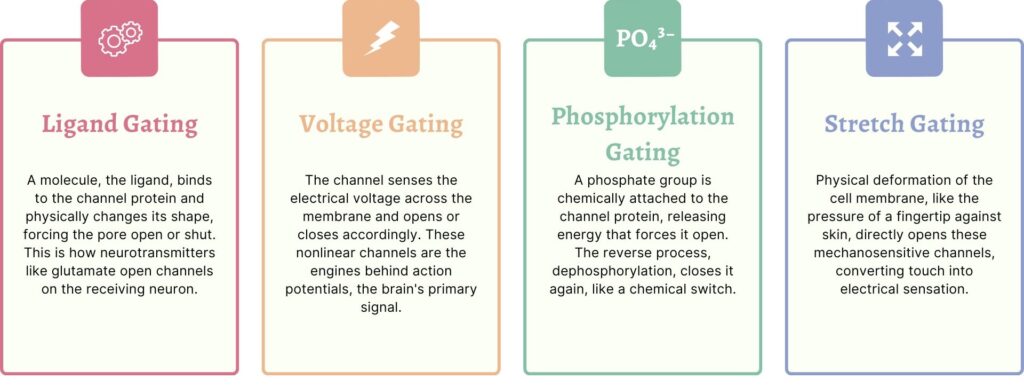
A channel that was permanently open would be useless, or rather, catastrophic. The brain requires precise, timed control. That control comes from a process called gating: the switching of channels between their OPEN and CLOSED states in response to specific signals. There are four known mechanisms by which this gating occurs, and each one is remarkable in its own way.
Voltage Gating and Action Potential
Of the four gating mechanisms, voltage gating is perhaps the most consequential for understanding how the brain communicates. Voltage-gated channels are found in high concentrations at a critical junction called the axon hillock. It is the point where the neuron’s cell body meets its long output cable called the axon.
When enough excitatory signals arrive from other neurons, the voltage at the axon hillock rises. If it crosses a threshold (typically around −55 millivolts) the voltage-gated sodium channels open. Sodium floods in, driving the voltage rapidly upward toward +40 millivolts. This surge in voltage opens even more sodium channels which is a positive feedback loop that produces a sharp, explosive spike of electrical activity known as the action potential.
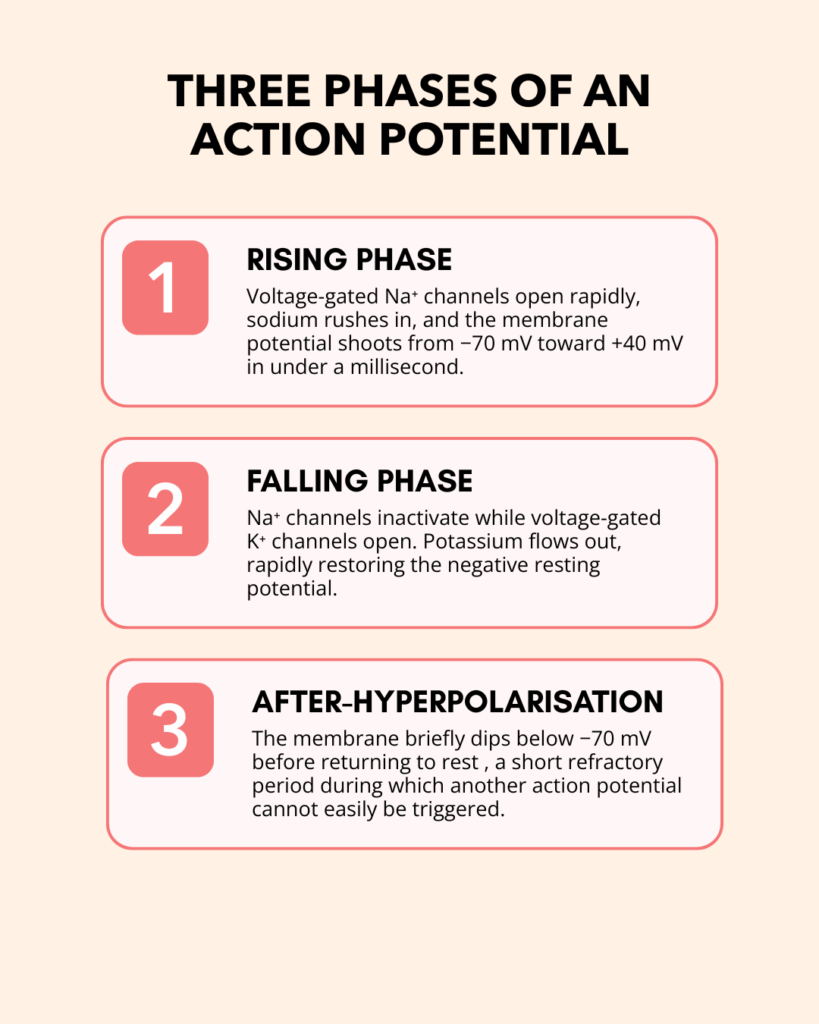
The action potential follows an all-or-nothing rule: either the threshold is crossed and the full spike fires, or nothing happens at all. There is no such thing as a “small” action potential. The neuron either fires or it doesn’t, a binary logic that forms the foundation of neural computation.
The Refractory Period: A Built-In Pause
After an action potential fires, the neuron enters a refractory period — a brief recovery window during which another spike cannot easily be generated. In the absolute refractory period, the voltage-gated sodium channels are inactivated, making a second action potential impossible regardless of how strong the stimulus is. In the subsequent relative refractory period, the cell is hyperpolarized below resting potential, meaning a stronger-than-normal stimulus is required to trigger another spike.
This pause is not a flaw — it is a feature. The refractory period ensures that action potentials travel in one direction only (away from the axon hillock), and it limits the maximum firing rate of a neuron, preventing runaway excitation.
Stretch Gating: Where Touch Becomes Thought
Stretch-gated channels offer perhaps the most vivid illustration of why ion channels are so philosophically astonishing. When you press your fingertip against a surface, the physical deformation of the skin is transmitted to the membranes of sensory nerve endings. This mechanical force literally pulls the channel protein open — no chemical signal required. Ions flow, a current is generated, and an electrical impulse races toward your brain.
In other words: a physical event in the world becomes an electrical event in your nervous system, mediated by a protein gate. The boundary between the physical and the mental runs, in part, right through an ion channel.
A Universe Inside the Membrane
It is easy to think of the brain as something grand and mysterious — lobes, networks, consciousness. But at the most fundamental level, the brain is a molecular machine. Its most basic operations are performed not by neurons firing in the abstract, but by individual protein channels, each a few nanometres wide, opening and closing in response to the world.
Ligand gating, voltage gating, phosphorylation, stretch — these four mechanisms collectively account for how every sensory experience is encoded, how every motor command is issued, and how learning and memory are physically inscribed in neural tissue. The tiny gates of the mind are not metaphors. They are the thing itself.
The next time you feel a thought forming, or a memory surfacing, or the touch of a hand — somewhere inside, a gate is opening.
thanks a lot of information greatfull
Happy that you liked it! 😊 More neuroscience, psychology, and AI posts are on the way. Hope to see you here again!